Nnamdi Kanu alleges coercion by DSS, says confessions were made under duress

Nnamdi Kanu alleges coercion by DSS, says confessions were made under duress
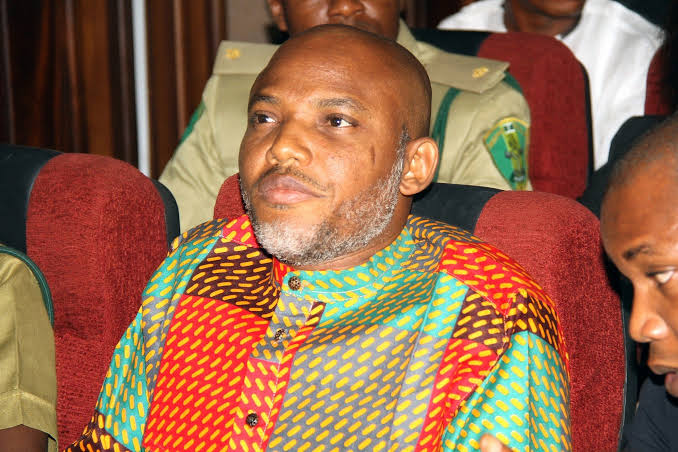
The detained leader of the Indigenous People of Biafra (IPOB), Nnamdi Kanu, on Wednesday accused the Department of State Services (DSS) of threatening and coercing him into making confessional statements following his arrest in 2015.
Kanu made the allegation during a trial-within-a-trial ordered by Justice James Omotosho of the Federal High Court, Abuja. The proceeding was initiated to determine the voluntariness of statements Kanu allegedly made to the DSS during his initial detention.
The development followed the testimony of the prosecution’s third witness—identified only as “CCC” who stated that he was among three DSS operatives who interviewed Kanu on multiple dates in October and November 2015.
He told the court that the sessions were recorded on video, and Kanu provided written statements after each one.
The Federal Government’s lead counsel, Adegboyega Awomolo (SAN), tendered two video CDs and three written statements purportedly authored by Kanu as evidence.
Although the defence initially did not object to the submission, Kanu’s lawyer, Paul Erokoro (SAN), later opposed it, stating that his client had informed him the statements were obtained under duress.
Erokoro alleged that Kanu was denied access to legal counsel, deprived of fresh air recommended for health reasons, and threatened with indefinite detention unless he complied with DSS demands.
Taking the stand during the trial-within-a-trial, Kanu described his alleged mistreatment. He said he was blindfolded, shackled, and flown from Lagos to Abuja without knowledge of his destination.
On arrival, he claimed he was held in solitary confinement in complete darkness.
He further accused one “Mr. Brown,” said to be an assistant director of investigations at the DSS, of threatening to revoke his limited privileges unless he cooperated.
“Mr. Brown threatened me that if I didn’t do what they asked, they would stop giving me that one-hour break,” Kanu told the court through his lawyer.
During cross-examination, Kanu maintained that parts of the video recordings had been edited and reiterated that he was compelled to write the statements under pressure from the DSS.
In response to the defence’s claims, the DSS witness denied any wrongdoing, insisting Kanu’s statements were voluntary. He said he never had access to Kanu’s cell but knew the gatekeepers who interacted with detainees.
When confronted with the possibility that another officer, like Mr. Brown, could have issued threats, the witness replied, “The DSS does not operate like that.”
Following the conclusion of the trial-within-a-trial, Justice Omotosho instructed both parties to submit their final written arguments by 9:00 a.m. on May 29.