
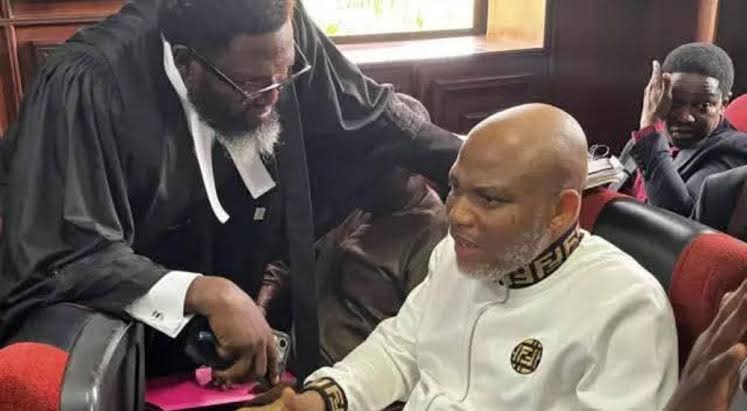
I have serious health conditions– Nnamdi Kanu reveals health struggles in DSS Custody, appeals to NMA

I have serious health conditions– Nnamdi Kanu reveals health struggles in DSS Custody, appeals to NMA
Nnamdi Kanu, the detained leader of the Indigenous People of Biafra (IPOB), has disclosed a list of serious health conditions he is currently battling while in the custody of Nigeria’s Department of State Services (DSS).
In a letter of complaint and appeal addressed to the Nigerian Medical Association (NMA), Kanu detailed multiple health issues, including tinnitus and sleep deprivation, which he described as among the “gravest threats” to his survival.
Kanu wrote that tinnitus, a condition characterized by a persistent internal sound, “exacerbates my hypertension”, placing him at heightened risk of “stroke, collapse, and sudden death.”
He also disclosed suffering from multiple other conditions, including diseases of the liver, pancreas, kidney, bladder, prostate, and white matter disease, as well as sleep apnea.
However, he emphasised that “most critically, tinnitus, the constant internal ‘chirping’ sound in my ears”, continues to severely affect his health.
The letter, titled ‘The Danger of Tinnitus and Sleep Deprivation’, reads in part: “Among the gravest threats to my survival today is tinnitus. The incessant chirping in my ears is more than a nuisance: It robs me of sleep, sometimes making rest completely impossible; It exacerbates my hypertension. It magnifies chest pain, fainting risks, and psychological strain; It undermines my body’s natural capacity to heal.”
He recounted a failed medical procedure by DSS doctors, stating: “DSS doctors once proposed to drain fluid from my inner ear but abandoned the plan due to the risk of permanent hearing loss. Since then, no serious effort has been made to treat this condition, even though its effects are cumulative and potentially devastating.”
Kanu further warned about the life-threatening combination of his ailments: “Sleep deprivation, when combined with existing hypertension, organ strain, and potassium instability, places me in immediate danger of stroke, collapse, or sudden death. Neglect of tinnitus and sleep deprivation shows a reckless disregard for the life-threatening impact of untreated conditions.”
The IPOB leader also accused a DSS-appointed doctor, Nasiru Mohammed, of falsifying his medical records: “From the moment he assumed control, Dr. Nasiru Mohammed began falsifying my test results, recording normal potassium levels when in reality they were dangerously low. When challenged as to why a potassium, sparing drug like Eplerenone was still prescribed if my potassium was supposedly normal, he provided no medical justification.”
Kanu claimed his health continued to deteriorate under Mohammed’s care: “Under his so-called care, I continued to experience: Frequent nosebleeds; Fainting episodes and near-collapse; Severe light-headedness; Unrelenting chest pains on my left side; Debilitating headaches; Swelling of the feet.
Over 50 blood samples have been taken during my time in DSS custody, but these have yielded no improvement in my health under the management of DSS-appointed doctors.”
He further alleged that the DSS prevented his longtime personal physician, Dr. Cfine, from treating him, using intimidation: “My longtime personal physician, Dr. Cfine, who has treated me faithfully for decades, was barred from access and intimidated into silence. This exclusion lasted until the intervention of Emeritus Professor Martin Aghaji, a globally respected surgeon and medical teacher. It was his timely intervention that saved me from imminent collapse.”
Kanu said that under Dr. Cfine’s care, his condition began to improve: “Potassium level rose modestly from 2.1 to 2.9 mmol/L — still below safe levels, but a clear sign of genuine medical progress. My episodes of nosebleeds, fainting, and light-headedness ceased. Swollen feet reduced, and the headaches subsided to an occasional level.”
Professor Aghaji also confirmed and documented broader health concerns, Kanu said: “In addition, Emeritus Professor Martin Aghaji confirmed and documented broader systemic health problems, including: Liver, pancreas, kidney, bladder, prostate, and white matter disease; Sleep apnea; and most critically, tinnitus the constant internal ‘chirping’ sound in my ears that often makes sleep impossible still persists and making my life unbearable.
“It is no exaggeration to say that without Emeritus Professor Martin Aghaji’s intervention, my health would have deteriorated beyond recovery. Yet instead of supporting him, the DSS has subjected him to the same pattern of intimidation used against Dr. Cfine.”

News
Scores of terrorists neutralised after Major attacks on military base

Scores of terrorists neutralised after Major attacks on military base
Nigerian troops have successfully neutralised several terrorists and thwarted coordinated attacks in Adamawa and Borno States.
The Joint Task Force, Operation Hadin Kai, announced that the successes followed swift and decisive responses by soldiers to attempts by insurgents to overrun military formations in the North-East.
In a statement issued on Friday, Acting Media Information Officer of the Task Force, Lieutenant Solomon Atokolo, confirmed that the operations resulted in heavy casualties for the terrorists.
He explained that the first attack took place in the early hours of January 16, 2026, when insurgents targeted a patrol base at Sabon Gari in Madagali Local Government Area of Adamawa State.
Atokolo stated that troops under Sector 4 of Operation Hadin Kai quickly engaged the attackers and successfully repelled them. He added that reinforcements from Gulak and the Battalion Quick Reaction Force were promptly mobilised to support the operation, ensuring that the assault was decisively crushed.
“The terrorists were successfully repelled without any casualty to our troops or damage to equipment, forcing them to abandon the attack,” the statement said.
He added that security forces later carried out clearance operations in the surrounding area, scanning for improvised explosive devices and booby traps to guarantee the safety of both civilians and personnel.
In a separate incident on the same day, terrorists staged a large-scale, multi-directional attack on Forward Operating Base (FOB) Azir in Borno State.
The attackers attempted to breach the base’s defensive perimeter but were met with fierce resistance from troops. With support from the Air Component and other Nigerian Army aerial platforms, the soldiers unleashed sustained firepower that compelled the insurgents to retreat.
Although rocket-propelled grenade fire from the terrorists damaged some troop-carrying vehicles and partially affected the base’s CCTV control room, Atokolo said troops maintained full control of the situation and prevented any further breach.
The military spokesperson disclosed that several weapons and ammunition were recovered from the fleeing terrorists.
Items seized included a 60mm mortar tube, mortar bombs, locally fabricated explosives, heavy machine gun rounds, and hundreds of rounds of 7.62mm NATO ammunition.
The Joint Task Force commended the professionalism and resilience of the troops, reaffirming its commitment to sustaining operations aimed at restoring lasting peace and security to the North-East region.
Scores of terrorists neutralised after Major attacks on military base
Nigerian troops have successfully neutralised several terrorists and thwarted coordinated attacks in Adamawa and Borno States.
The Joint Task Force, Operation Hadin Kai, announced that the successes followed swift and decisive responses by soldiers to attempts by insurgents to overrun military formations in the North-East.
In a statement issued on Friday, Acting Media Information Officer of the Task Force, Lieutenant Solomon Atokolo, confirmed that the operations resulted in heavy casualties for the terrorists.
He explained that the first attack took place in the early hours of January 16, 2026, when insurgents targeted a patrol base at Sabon Gari in Madagali Local Government Area of Adamawa State.
Atokolo stated that troops under Sector 4 of Operation Hadin Kai quickly engaged the attackers and successfully repelled them. He added that reinforcements from Gulak and the Battalion Quick Reaction Force were promptly mobilised to support the operation, ensuring that the assault was decisively crushed.
“The terrorists were successfully repelled without any casualty to our troops or damage to equipment, forcing them to abandon the attack,” the statement said.
He added that security forces later carried out clearance operations in the surrounding area, scanning for improvised explosive devices and booby traps to guarantee the safety of both civilians and personnel.
In a separate incident on the same day, terrorists staged a large-scale, multi-directional attack on Forward Operating Base (FOB) Azir in Borno State.
The attackers attempted to breach the base’s defensive perimeter but were met with fierce resistance from troops. With support from the Air Component and other Nigerian Army aerial platforms, the soldiers unleashed sustained firepower that compelled the insurgents to retreat.
Although rocket-propelled grenade fire from the terrorists damaged some troop-carrying vehicles and partially affected the base’s CCTV control room, Atokolo said troops maintained full control of the situation and prevented any further breach.
The military spokesperson disclosed that several weapons and ammunition were recovered from the fleeing terrorists.
Items seized included a 60mm mortar tube, mortar bombs, locally fabricated explosives, heavy machine gun rounds, and hundreds of rounds of 7.62mm NATO ammunition.
The Joint Task Force commended the professionalism and resilience of the troops, reaffirming its commitment to sustaining operations aimed at restoring lasting peace and security to the North-East region.
News
Federal Govt warns States against negotiating with Bandits
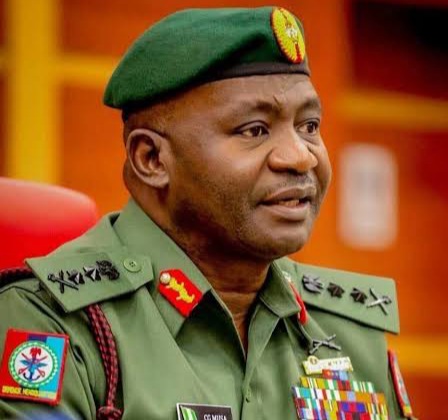
Federal Govt warns States against negotiating with Bandits
The Minister of Defence, Christopher Musa, has urged state governments across the country to stop engaging in negotiations with bandits, warning that such actions undermine national security efforts.
Musa made the call during an interview with BBC Hausa, where he expressed concern that dialogue with criminal groups weakens ongoing military operations.
According to him, reaching agreements with bandits often proves futile, as they cannot be trusted to honour their commitments.
He argued that many of the criminals lack genuine remorse and are likely to renege on any deals struck with them.
The minister disclosed that the Katsina State Government was cautioned over its recent decision to facilitate the release of 70 suspected bandits from custody.
However, the Katsina government had defended the action, describing the move as essential to consolidating community-driven peace agreements with “repentant bandits” in several local government areas.
“Negotiation with bandits is not a way out, those people are not real, whenever they come for reconciliation, they need something,” Musa spoke in Hausa language.
“What’s happening in Katsina we told them, don’t ever make the mistake of reconciling with those people, they are liars.
“We begged people to stop negotiating with them and the government should stop. It’s not right and they will surely come back again. They don’t fear God.
“We already informed them it damages our work, we asked them to stop, you know it’s democracy now not military rule. But we are in talk with them.”
The defence minister refuted claim that the federal government pays ransom to kidnappers.
“Paying ransom is not good. People should stop paying ransom when they kidnap people. Report should be made and actions will be taken.”
“Federal government doesn’t pay for ransom. It might be other people and they are doing that on their own.”
-
6 years ago
Our situation in Kano terrible – Gov Ganduje cries out
-

 News11 months ago
FG pledges commitment to enhance Police officers Welfare, implement Tinubu’s 8-point agenda for NPF
-
 News11 months ago
BREAKING; NSCDC gets approval to commence 2025 recruitment exercise
-

 News9 months ago
Alleged cocaine deal: Court issues orders in suspended DCP Abba Kyari’s case
-

 News12 months ago
DPO under investigation for allegedly taking teenage girl to his home while in police custody
-

 News12 months ago
JUST IN; Commissioner of Police bows out of Service
-

 News9 months ago
JUST IN; Police Inspector dies watching Arsenal match
-

 News12 months ago
BREAKING; NLC declare nationwide protest