
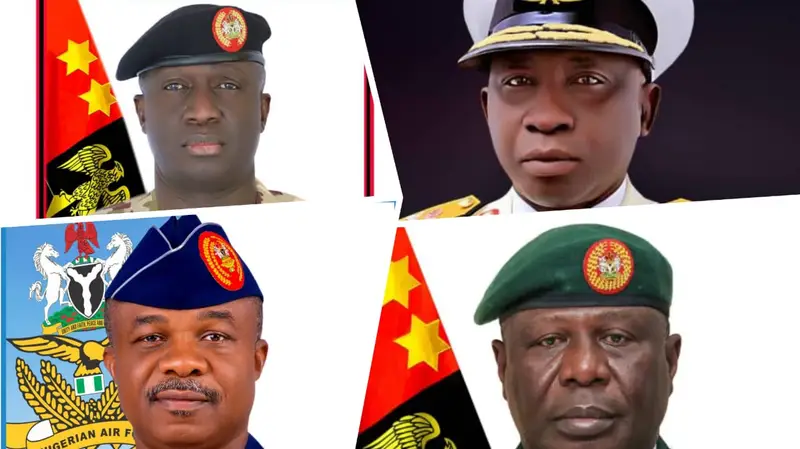
New Service Chiefs and the task ahead

New Service Chiefs and the task ahead
In his message to the newly appointed Service Chiefs, President Bola Tinubu emphasised professionalism, discipline, and the need for results-driven operations.
“The security and safety of every Nigerian is paramount; you have a duty to deliver measurable outcomes,” he said.
For many Nigerians, this call underscores the urgency of national security renewal; a call that now rests squarely on the shoulders of the new military chiefs.
The president’s decision to inject fresh energy into the military leadership has been widely commended as a step in the right direction — not only for its symbolism but also for its strategic implications.
The appointments, analysts say, reflect Tinubu’s understanding that modern warfare requires new thinking, adaptive leadership, and a deep commitment to inter-agency coordination.
At the apex of Nigeria’s military hierarchy is the Chief of Defence Staff (CDS), whose principal task is to ensure synergy among the Army, Navy, and Air Force.
The role of the CDS goes beyond coordination; it embodies strategic alignment, unified planning, and the creation of a seamless command structure capable of responding swiftly to emerging threats.
Observers say the new CDS, Lt.-Gen. Olufemi Oluyede, is expected to deepen joint operations and intelligence fusion, ensuring that rivalries or silos between the services are replaced with cooperation and shared objectives.
In the fight against terrorism and insurgency, real-time intelligence, tactical mobility, and the effective use of technology will determine the tempo and outcome of operations.
Security analysts also stress the need for the Defence Headquarters to enhance inter-agency cooperation — especially among the Armed Forces, Police, Department of State Services, and the Nigeria Security and Civil Defence Corps.
With improved communication, shared databases, and coordinated field missions, Nigeria’s fight against insurgency and banditry could achieve greater results with fewer resources.
The Nigerian Army, now to be led by Maj.-Gen. Waidi Shaibu, remains the largest and most visible component of the Armed Forces, with troops deployed in nearly every state of the federation for various internal security operations.
The new Chief of Army Staff (COAS) faces the enormous challenge of sustaining the momentum against terrorists, bandits, and violent extremists, while also addressing structural issues such as troop welfare, logistics, and civil-military relations.
In the North-East, Operation Hadin Kai continues to yield positive outcomes, with sustained pressure on Boko Haram and ISWAP remnants.
Yet, analysts say, the battle is far from over; pockets of resistance, asymmetric ambushes, and sleeper cells still threaten hard-won gains.
For Shaibu, the agenda is clear: consolidate the successes of Operation Hadin Kai, enhance the mobility and responsiveness of troops under Operations Whirl Stroke, Safe Haven, and Delta Safe, and maintain focus on intelligence-led operations.
Equally vital, according to security experts, is the issue of personnel welfare.
Soldiers in the field continue to make immense sacrifices, often in difficult terrain and under challenging conditions; ensuring that they are properly equipped, trained, and motivated remains a core part of military effectiveness.
The army’s continued engagement in civil-military projects, such as building schools, providing medical outreach, and supporting local communities, helps reinforce the bond between citizens and the Armed Forces.
The new army leadership is therefore expected to deepen these community-focused initiatives, recognising that the fight against insecurity is as much about hearts and minds as it is about firepower.
Coming to the Nigerian Navy, the nation’s maritime environment is both an asset and liability.
With more than 853 kilometres of coastline and an expansive Exclusive Economic Zone (EEZ), the country depends heavily on maritime routes for trade, energy supply, and revenue generation.
The new Chief of Naval Staff (CNS), Rear Adm. Idi Abbas, inherits an institution that has made significant progress in recent years, notably in reducing piracy, illegal bunkering, and crude oil theft through operations such as Dakatar Da Barawo and Water Guard.
However, the challenges remain formidable.
Illegal fishing, smuggling, and maritime crime continue to threaten economic stability and national security.
The Navy’s modernisation drive, including the acquisition of new offshore patrol vessels, drones, and surveillance systems, is expected to continue under the new leadership.
Equally important is regional cooperation.
The Gulf of Guinea remains one of the world’s most sensitive maritime corridors, and Nigeria’s leadership role within the Yaoundé Code of Conduct framework is crucial for sustained maritime security.
Analysts believe that the new CNS will need to strengthen intelligence sharing with regional navies and enhance Nigeria’s participation in multinational operations to safeguard its maritime interests.
The Nigerian Air Force (NAF), under its new Chief of Air Staff (CAS), AVM Sunday Aneke, is poised to expand its strategic role in both combat and humanitarian operations.
The NAF’s precision strikes have been instrumental in decimating terrorist enclaves, disrupting logistics corridors, and supporting ground troops in complex terrains.
The integration of drones, surveillance aircraft, and precision-guided munitions has transformed the Air Force into a key player in Nigeria’s asymmetric warfare landscape.
Going forward, experts suggest that the new CAS should focus on capacity building — investing in pilot training, aircraft maintenance, and indigenous technology production.
Strengthening local research partnerships, such as those with the Air Force Institute of Technology (AFIT) in Kaduna, could help Nigeria reduce dependency on foreign suppliers and enhance sustainability.
Moreover, the Air Force’s expanding humanitarian role, from medical evacuations to emergency relief, underscores its growing importance beyond combat.
The new leadership is expected to sustain this dual function, aligning with Nigeria’s broader national development agenda.
On the whole, beyond tactical operations, the new service chiefs face the challenge of redefining Nigeria’s defence strategy to meet contemporary realities.
In his view, a former Director of Peacekeeping Operations with the Nigerian Army and Commander of Operation Safe Haven, retired Maj.-Gen. Anthony Atolagbe, said that the change would generate excitement within the military.
Atolagbe had, during a television programme, opined that there would be some excitement in the Armed Forces because of the new redeployment.
According to him, it is going to make the military align properly with its procedures, or the necessary steps that need to be taken in the career progression of officers.
Also, military scholar, Dr Sani Abubakar, said the newly appointed service chiefs face a monumental challenge, adding that there were high expectations from the general populace and the military community.
Abubakar said the government’s foremost duty of ensuring the safety of all citizens must be actualised through positive actions from the new military leadership.
According to him, the North-East and North-West regions remain conflict zones and have recently witnessed a troubling increase in Boko Haram attacks targeting both civilians and military installations.
“Mafa, the hometown of the Borno Governor, has been under constant attacks.
“Similarly, places like Ngamdu, Dikwa, Gajibo, and Ngala were also affected.
“Niger and some parts of Kwara and Plateau are also red zones; armed opposition groups are having a good time in those places; this significant challenge lies ahead for the new service chiefs.
“The time has passed for merely announcing that they have thwarted or ‘repelled’ attacks; now, they must be recognised for their strategic planning and offensive operations against all armed groups that threaten the state’s authority and its legitimate claim to exercise the monopoly of violence.”
Abubakar said that Nigerians craved for genuine security and freedom from fear and threats that loomed over them on roads, in agricultural fields, schools, and even within their own homes.
According to him, it is insufficient to focus solely on regime security; the service chiefs should aim for comprehensive national and human security.
“Additionally, soldiers have their own set of expectations; it is crucial to ensure they are adequately equipped with night vision devices, military-grade drones, automatic rifles, sufficient ammunition, helicopters, MRAPs, and improvements to their welfare.
“Ultimately, it is essential for the new service chiefs to lead with integrity and effective governance as outlined by the Geneva Centre for Security Sector Governance and Reform,” he said.
The mood across the country reflects cautious optimism.
From local communities in the North-East to the Niger-Delta, citizens expect not only improved security but also a visible difference in military conduct and engagement.
The task before them is enormous: to defend a nation of more than 200 million people, restore peace in troubled regions, and project Nigeria as a force for stability in West Africa.
Observers say history will judge this team not by their appointments but by their achievements, by how they translate strategy into security, policy into peace, and command into confidence.
For the men and women of the Nigerian Armed Forces, the message is clear: a new chapter has begun, and with it, a renewed sense of mission. (NANFeatures)

News
Tinubu mourns Abubakar’s passing, the Imam who shielded over 200 Christians in his mosque during communal riot
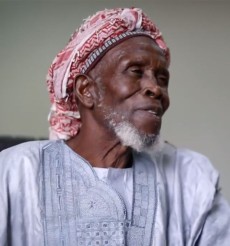
Tinubu mourns Abubakar’s passing, the Imam who shielded over 200 Christians in his mosque during communal riot
President Bola Tinubu has expressed deep sorrow over the death of Imam Abdullahi Abubakar, Chief Imam of Nghar village, Barkin Ladi Local Government Area of Plateau, who passed away at 92.
This is contained in a statement issued by Presidential Spokesperson, Mr Bayo Onanuga, on Friday in Abuja.
The late cleric gained national and international recognition in 2018 for sheltering more than 200 Christians during communal violence in Plateau.
Tinubu described Abubakar as an extraordinary religious leader whose life exemplified faith, courage and a deep reverence for the sanctity of human life.
“At such a time when tribal and religious tendencies seemed to overwhelm reason, Imam Abubakar stood firmly on the side of peace, benevolence and conscience.
“Mindless of the enormous risk to his own life, the noble cleric chose humanity over division, love as opposed to hatred and embrace rather than rejection,” the President said.
He said the Imam’s actions embodied the true essence of faith and delivered a powerful message beyond sermons.
The President noted that the cleric’s uncommon bravery earned him local and international honours celebrating peaceful coexistence.
“I urge religious and community leaders to imbibe and preach the spirit of tolerance, mutual respect and peaceful togetherness as expounded in the life of Imam Abubakar,” Tinubu said.
He prayed that God grants the late Imam eternal rest and rewards him for his courage and good deeds. (NAN)
News
Govt. introduces solar installation, garment making, GSM repairs in jss curriculum

Govt. introduces solar installation, garment making, GSM repairs in jss curriculum
The Anambra Government has introduced 15 entrepreneurial subjects into the Junior Secondary School (JSS) curriculum to enhance students’ practical skills and foster an entrepreneurial mindset.
The News Agency of Nigeria (NAN) reports that the new subjects include solar installation, garment making, GSM repairs, agriculture and processing, plumbing, tiling, POP installation and event management.
Others are bakery, hairstyling, make-up, interior design, CCTV/intercom installation, digital literacy, information technology and robotics.
Prof. Nkechi Ikediugwu, Chairperson ,Post Primary Schools Service Commission (PPSSC), while speaking at the occasion in Awka on Friday, said the initiative was aimed at repositioning education to meet contemporary needs.
Ikediugwu noted that in a rapidly changing world, education should go beyond theory and examinations to equip students with practical skills, creativity, innovation and an entrepreneurial mindset.
“The goal of the programme is to prepare learners, not only to seek jobs but to create value, generate employment and contribute meaningfully to the economic development of the state,”she said.
Mr Cyril Nwuche of Nnamdi Azikiwe University, Awka, delivered a paper titled “Building Entrepreneurial Secondary Schools: Why Every School Needs an Entrepreneurship Club”.
Nwuche said the introduction of entrepreneurial subjects showed that the government was on the path to transforming the state’s economy.
“Traditional academic instruction alone is no longer sufficient to prepare children for the future.
“There is the need for schools to embrace practical and skill-based learning to enable students to thrive in a dynamic global environment, ” he said. (NAN)
News
Two men docked for allegedly defiling underaged girl

Two men docked for allegedly defiling underaged girl
The police in Lagos on Friday, charged two men before an Ikeja Chief Magistrates’ Court for allegedly defiling an 11- year-old girl.
The defendants are: Prince Tomnyie, 40, a businessman, who resides at Agege, and Micheal Adenuga, 24, a furniture maker, who resides at Atere Street in Lekki.
They are standing trial on charges of defilement, and had each pleaded not guilty to the charges.
The prosecutor, ASP Adegoke Ademigbuji told the court that they committed the offence sometimes in December 2024, and September 2025, at Langbasa Ajah and Igbara Lekki, Lagos .
The prosecutor alleged that the victim’s father, had taken his daughter for medical check and it was discovered that the minor had been defiled.
The prosecution alleged that the victim had told her father that his friend, Tomnyie, defiled her sometimes ago.
Ademigbuji alleged that the victim also mentioned the second defendant’s name who lives in their neigbourhood.
The offence contravenes the provisons of section 137 of the Criminal Law of Lagos, 2015.
The Chief Magistrate, Mr L. A Owolabi, granted the defendants bail in the sum of of N600,000 each, with two sureties each in like sum.
He adjourned the case until March 5, for mention. (NAN)
-
6 years ago
Our situation in Kano terrible – Gov Ganduje cries out
-

 News11 months ago
FG pledges commitment to enhance Police officers Welfare, implement Tinubu’s 8-point agenda for NPF
-
 News11 months ago
BREAKING; NSCDC gets approval to commence 2025 recruitment exercise
-

 News9 months ago
Alleged cocaine deal: Court issues orders in suspended DCP Abba Kyari’s case
-

 News12 months ago
DPO under investigation for allegedly taking teenage girl to his home while in police custody
-

 News12 months ago
JUST IN; Commissioner of Police bows out of Service
-

 News9 months ago
JUST IN; Police Inspector dies watching Arsenal match
-

 News12 months ago
BREAKING; NLC declare nationwide protest