
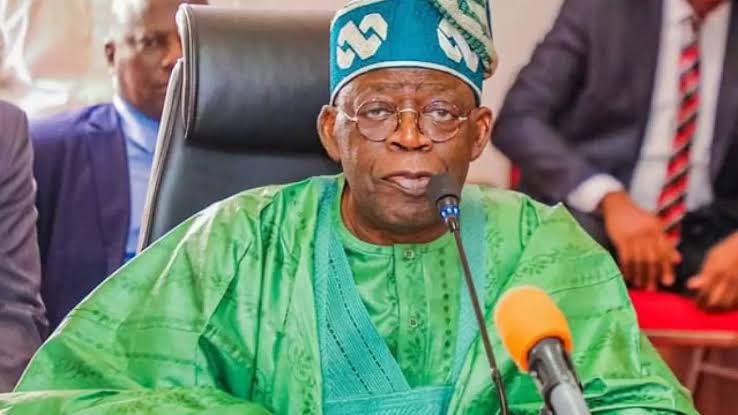
Traditional Rulers across Nigeria deserve constitutional role says President Tinubu

Traditional Rulers across Nigeria deserve constitutional role says President Tinubu
President Bola Tinubu says traditional rulers remains the most enduring link between government and the people and must be formally recognised within the governance framework.
Tinubu, who was represented by Gov. Hope Uzodinma of Imo, disclosed this at the meeting of the National Council of Traditional Rulers of Nigeria (NCTRN) on Monday in Lagos.
The News Agency of Nigeria (NAN) reports that the meeting has as theme, “The Traditional Institution: The Imperative of Its Inclusion in the Effective and Efficient Governance in Nigeria.”
The meeting brought together royal fathers from across the country to deliberate on the constitutional relevance of traditional leadership in modern governance.
Tinubu said that the traditional institution continued to perform crucial roles in promoting peace, cohesion and stability, in spite of the absence of constitutional backing.
“Across the country, our traditional rulers carry out essential responsibilities that keep our communities united and functional; mediating conflicts, preserving culture, and maintaining order,” he said.
Tinubu recalled that traditional rulers had defined roles in the country’s early constitutional order, citing the 1963 Republican Constitution, which gave them legislative presence and participation in governance.
He lamented that the 1979 and 1999 constitutions failed to restore such recognition, leaving the institution to operate informally.
“This is not a question of nostalgia but one of institutional continuity.
“Our royal fathers are still doing the work; what they need is formal recognition by law,” he said.
The president urged the National Assembly to revisit the issue, stressing that some African countries like Ghana, South Africa, and Namibia had already constitutionally entrenched their traditional institutions without undermining democracy.
He described the traditional institution as indispensable to Nigeria’s unity and stability, adding that the time had come to grant legal backing to the functions traditional rulers already perform.
“The marriage between governance and tradition is real. The only thing missing is the certificate,” he said.
He, however, advised monarchs to remain neutral in politics, saying their moral authority and public trust were crucial to sustaining their influence and dignity.
Earlier in his welcome address, Gov. Babajide Sanwo-Olu of Lagos State, said Lagos was honoured to host the assembly of cultural custodians whose wisdom and leadership continued to uphold the nation’s moral fabric.
Sanwo-Olu described the meeting as timely, noting that traditional institutions had always served as the trusted bridge between the people and government.
“Long before modern governance took shape, our traditional rulers were the bedrock of stability and justice.
“Even today, no government can thrive without their support,” he said.
The governor recounted the historical contributions of monarchs who resisted colonial rule, including Oba Ovonramwen Nogbaisi of Benin, King Jaja of Opobo, and Chief Ogedengbe of Ilesha.
According to him, military intervention in governance weakened the traditional system, but democracy offers an opportunity for restoration.
“Our royal fathers must continue to push for constitutionally backed relevance. Lagos will always support this cause,” Sanwo-Olu said.
He urged the traditional rulers to remain impartial and united, emphasising their role as moral compasses and symbols of peace and integrity.
“We must ensure that our traditional institutions remain inclusive, impartial, and aligned with the vision of a just and thriving Nigeria,” he added.
Sanwo-Olu reaffirmed his administration’s commitment to the welfare and dignity of traditional rulers, pledging continued support for constitutional recognition of their roles in national development.
Sultan of Sokoto, Alhaji Muhammad Sa’ad Abubakar III, Chairman of the NCTRN, commended Tinubu for his commitment to national unity and expressed optimism that the discussions would lead to stronger institutional recognition for traditional rulers.
The Sultan urged traditional rulers to sustain their efforts in promoting peace and security in their domains, while describing their collaboration with government as key to building a stable and prosperous nation.(NAN)

News
Scores of terrorists neutralised after Major attacks on military base

Scores of terrorists neutralised after Major attacks on military base
Nigerian troops have successfully neutralised several terrorists and thwarted coordinated attacks in Adamawa and Borno States.
The Joint Task Force, Operation Hadin Kai, announced that the successes followed swift and decisive responses by soldiers to attempts by insurgents to overrun military formations in the North-East.
In a statement issued on Friday, Acting Media Information Officer of the Task Force, Lieutenant Solomon Atokolo, confirmed that the operations resulted in heavy casualties for the terrorists.
He explained that the first attack took place in the early hours of January 16, 2026, when insurgents targeted a patrol base at Sabon Gari in Madagali Local Government Area of Adamawa State.
Atokolo stated that troops under Sector 4 of Operation Hadin Kai quickly engaged the attackers and successfully repelled them. He added that reinforcements from Gulak and the Battalion Quick Reaction Force were promptly mobilised to support the operation, ensuring that the assault was decisively crushed.
“The terrorists were successfully repelled without any casualty to our troops or damage to equipment, forcing them to abandon the attack,” the statement said.
He added that security forces later carried out clearance operations in the surrounding area, scanning for improvised explosive devices and booby traps to guarantee the safety of both civilians and personnel.
In a separate incident on the same day, terrorists staged a large-scale, multi-directional attack on Forward Operating Base (FOB) Azir in Borno State.
The attackers attempted to breach the base’s defensive perimeter but were met with fierce resistance from troops. With support from the Air Component and other Nigerian Army aerial platforms, the soldiers unleashed sustained firepower that compelled the insurgents to retreat.
Although rocket-propelled grenade fire from the terrorists damaged some troop-carrying vehicles and partially affected the base’s CCTV control room, Atokolo said troops maintained full control of the situation and prevented any further breach.
The military spokesperson disclosed that several weapons and ammunition were recovered from the fleeing terrorists.
Items seized included a 60mm mortar tube, mortar bombs, locally fabricated explosives, heavy machine gun rounds, and hundreds of rounds of 7.62mm NATO ammunition.
The Joint Task Force commended the professionalism and resilience of the troops, reaffirming its commitment to sustaining operations aimed at restoring lasting peace and security to the North-East region.
Scores of terrorists neutralised after Major attacks on military base
Nigerian troops have successfully neutralised several terrorists and thwarted coordinated attacks in Adamawa and Borno States.
The Joint Task Force, Operation Hadin Kai, announced that the successes followed swift and decisive responses by soldiers to attempts by insurgents to overrun military formations in the North-East.
In a statement issued on Friday, Acting Media Information Officer of the Task Force, Lieutenant Solomon Atokolo, confirmed that the operations resulted in heavy casualties for the terrorists.
He explained that the first attack took place in the early hours of January 16, 2026, when insurgents targeted a patrol base at Sabon Gari in Madagali Local Government Area of Adamawa State.
Atokolo stated that troops under Sector 4 of Operation Hadin Kai quickly engaged the attackers and successfully repelled them. He added that reinforcements from Gulak and the Battalion Quick Reaction Force were promptly mobilised to support the operation, ensuring that the assault was decisively crushed.
“The terrorists were successfully repelled without any casualty to our troops or damage to equipment, forcing them to abandon the attack,” the statement said.
He added that security forces later carried out clearance operations in the surrounding area, scanning for improvised explosive devices and booby traps to guarantee the safety of both civilians and personnel.
In a separate incident on the same day, terrorists staged a large-scale, multi-directional attack on Forward Operating Base (FOB) Azir in Borno State.
The attackers attempted to breach the base’s defensive perimeter but were met with fierce resistance from troops. With support from the Air Component and other Nigerian Army aerial platforms, the soldiers unleashed sustained firepower that compelled the insurgents to retreat.
Although rocket-propelled grenade fire from the terrorists damaged some troop-carrying vehicles and partially affected the base’s CCTV control room, Atokolo said troops maintained full control of the situation and prevented any further breach.
The military spokesperson disclosed that several weapons and ammunition were recovered from the fleeing terrorists.
Items seized included a 60mm mortar tube, mortar bombs, locally fabricated explosives, heavy machine gun rounds, and hundreds of rounds of 7.62mm NATO ammunition.
The Joint Task Force commended the professionalism and resilience of the troops, reaffirming its commitment to sustaining operations aimed at restoring lasting peace and security to the North-East region.
News
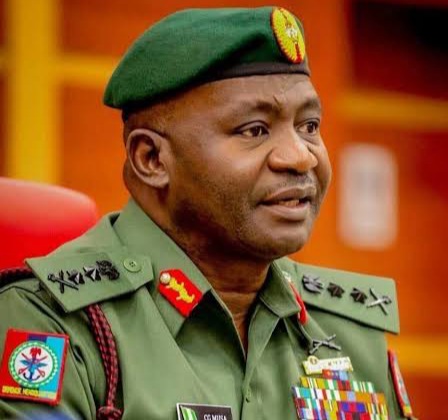
Federal Govt warns States against negotiating with Bandits
Federal Govt warns States against negotiating with Bandits
The Minister of Defence, Christopher Musa, has urged state governments across the country to stop engaging in negotiations with bandits, warning that such actions undermine national security efforts.
Musa made the call during an interview with BBC Hausa, where he expressed concern that dialogue with criminal groups weakens ongoing military operations.
According to him, reaching agreements with bandits often proves futile, as they cannot be trusted to honour their commitments.
He argued that many of the criminals lack genuine remorse and are likely to renege on any deals struck with them.
The minister disclosed that the Katsina State Government was cautioned over its recent decision to facilitate the release of 70 suspected bandits from custody.
However, the Katsina government had defended the action, describing the move as essential to consolidating community-driven peace agreements with “repentant bandits” in several local government areas.
“Negotiation with bandits is not a way out, those people are not real, whenever they come for reconciliation, they need something,” Musa spoke in Hausa language.
“What’s happening in Katsina we told them, don’t ever make the mistake of reconciling with those people, they are liars.
“We begged people to stop negotiating with them and the government should stop. It’s not right and they will surely come back again. They don’t fear God.
“We already informed them it damages our work, we asked them to stop, you know it’s democracy now not military rule. But we are in talk with them.”
The defence minister refuted claim that the federal government pays ransom to kidnappers.
“Paying ransom is not good. People should stop paying ransom when they kidnap people. Report should be made and actions will be taken.”
“Federal government doesn’t pay for ransom. It might be other people and they are doing that on their own.”
-
6 years ago
Our situation in Kano terrible – Gov Ganduje cries out
-

 News11 months ago
FG pledges commitment to enhance Police officers Welfare, implement Tinubu’s 8-point agenda for NPF
-

 News11 months ago
BREAKING; NSCDC gets approval to commence 2025 recruitment exercise
-

 News9 months ago
Alleged cocaine deal: Court issues orders in suspended DCP Abba Kyari’s case
-

 News12 months ago
DPO under investigation for allegedly taking teenage girl to his home while in police custody
-

 News12 months ago
JUST IN; Commissioner of Police bows out of Service
-

 News9 months ago
JUST IN; Police Inspector dies watching Arsenal match
-

 News12 months ago
BREAKING; NLC declare nationwide protest