
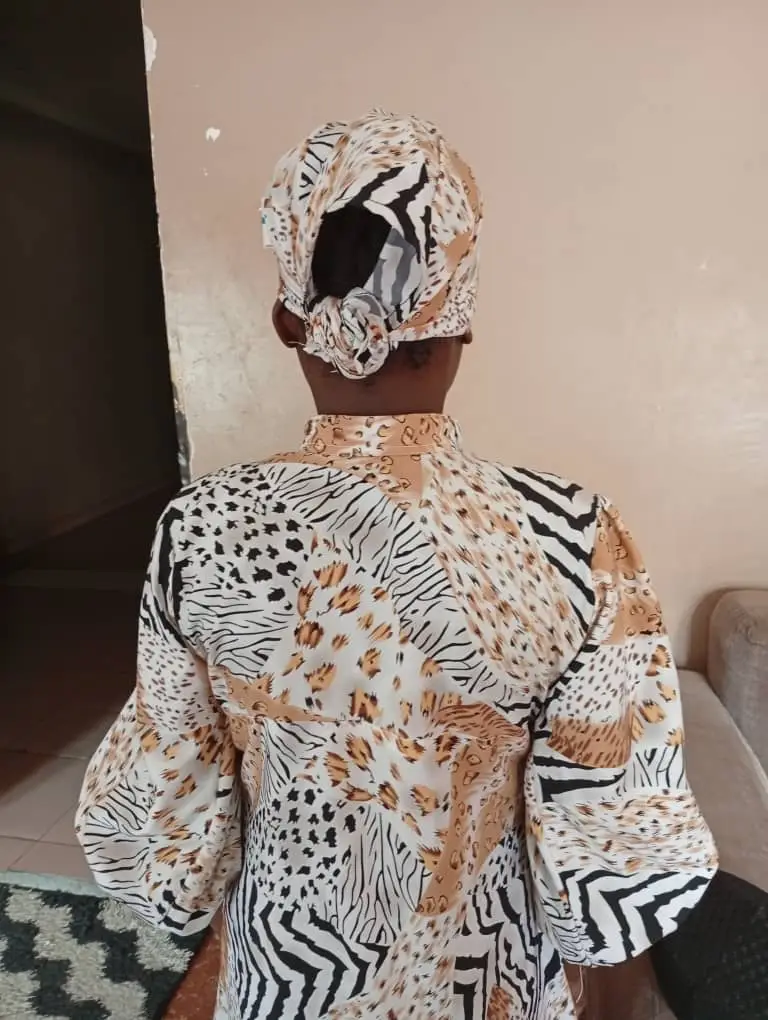
Pathetic, How underaged Nigerian Girls are denied School, trafficked, exploited

Pathetic, How underaged Nigerian Girls are denied School, trafficked, exploited
At just 10 years old, Ladidi Mudi (not real name) wakes at 5:00 a.m. daily. But unlike children her age who prepare for school, her mornings begin with sweeping, mopping, and washing dishes in the home of a stranger she calls “mummy” in Unguwan Rimi, GRA, Kaduna.
Though she lives with her employer, Ladidi worries most about not seeing her mother for months.
“I don’t plan to stay here for long. I want to go back home. I am tired of the city,” she said quietly.
Ladidi is one of the 24.7 million Nigerian children trapped in child labour. The 2022 Child Labour and Forced Labour Survey shows 39.2 per cent of children aged 5–17 are in child labour. Of these, 29.9 per cent are in hazardous work.
The figures are worse in rural Nigeria, where 45 per cent of children work compared to 30 per cent in cities.
In the North-west, 6.4 million children are in labour, with over half doing hazardous tasks. Many do not attend school, making states like Jigawa rank highest in out-of-school children.
Born in Jigawa, Ladidi’s parents are too poor to care for her. Her mother sells kuli-kuli while her father farms. Hoping to ease the family’s burden, they allowed an agent to send Ladidi to Kaduna as a maid.
“I never attended a conventional school in my village. I only went to Quranic school and sometimes helped my mum hawk kuli-kuli. I want to learn how to read and write and be a teacher,” she said.
Before her current placement, Ladidi briefly worked in another Kaduna home but begged to return to Jigawa due to the exhausting workload. Instead, the agent reassigned her to a new employer. She works with 15-year-old Raliya, also from Jigawa.
Their employer, a career woman, explained why she prefers underaged maid.
“They are easier to groom and less likely to cause problems. Older girls often sneak out and mingle with men. I don’t have that time,” she said.
Unlike Ladidi, Raliya seemed more comfortable. She said she had been in the house for 11 months and that their employer provided food, clothes, and medical care. Still, she does not attend school.
“I don’t know my salary. My uncle sent me here after my father died. Madam says she’s saving my money until I go back. I have never been to school. I want to learn how to read and write,” Raliya explained.
The System of Trafficking
Kaduna is a key hub for minors trafficked from neighbouring states like Jigawa and Katsina.
Labaran Ado-Tanimu, State Commander of the National Agency for the Prohibition of Trafficking in Persons (NAPTIP), said Kaduna functions as a source, transit, and destination for trafficking.
“Children are brought from rural communities to work as maids, labourers, or worse, for sexual exploitation. Many are under 18, some as young as 10,” he said.
Trafficking persists in spite of awareness campaigns. Most traffickers are women who operate networks linking rural agents with urban employers.
“An employer tells an agent the type of maid they want. The agent contacts someone in the village to source a girl. The child is then transported like goods, sometimes handed to commercial drivers who deliver them straight to the city agent or employer,” Ado-Tanimu.
He added that poverty and ignorance fuel the trade. Many parents willingly give away children, hoping for income to buy goats or cows, believing it benefits the girl’s future.
Undercover Experience
To understand the system, I went undercover as a career woman seeking a maid under 18.
Through contacts, l obtained the number of a woman who connected me to an agent named Rahma. When I asked for a 12–13-year-old, she replied:
“There are no girls now. Wait until Wednesday when they usually arrive.”
That week passed and she called back, saying two girls had arrived but were quickly taken by other employers. “They’re in high demand,” she added.
After Eid-el-Kabir, she informed me another girl was available in Unguwan Sarki. She directed me to Dahiru Road, Kurmin Mashi, to meet her.
Rahma, a young woman in her mid-twenties living with her widowed mother, admitted she linked girls from Kano and Jigawa to households in Kaduna. The main agent, “Maman Rabi,” paid her commissions of N1,000 to N2,000 per child.
We waited hours for Maman Rabi, who eventually sent word she was busy. Later, Rahma suggested I take a young divorcée or widow instead. I declined, sticking to my request for a younger girl.
Two weeks later, Rahma called, “Two girls have landed in Kaduna. They came from Kano. You’ll refund N7,000 for their transport, pay N5,000 agent fee, and offer the girl at least N10,000 salary.”
We met near a filling station in Unguwan Rimi where Rahma arrived with a girl in purple hijab who said she was 18.
I rejected her, asking for someone younger. Rahma then led me to Millennium City to meet Maman Rabi, who presented another girl, 15 years old.
When I asked how to pay salaries, the agent said I could keep the money until the girl was ready to return home.
Before finalising, I requested a photo of the girl to show my “sister.” They agreed.
I paid N9,000 for transport and promised to return in the evening to pick her up—ending the undercover mission.
The Laws
Nigeria has passed several laws against trafficking. The Trafficking in Persons (Prohibition) Enforcement and Administration Act (2003, amended in 2005, re-enacted in 2015) prohibits all forms of human trafficking, including recruitment, transportation, and harbouring of children for exploitation.
It prescribes a minimum sentence of five years’ imprisonment and fines between N1 million and N5 million, with stricter penalties when minors are involved. The law also established NAPTIP as the lead agency on enforcement and victim support.
The Child Rights Act (CRA) of 2003 further protects children. Section 30 criminalises buying, selling, or hiring children in any form, while Section 32 bans the use of children for begging, hawking, sexual exploitation, or domestic servitude. Violators face up to five years’ imprisonment or heavy fines.
However, because the CRA is federal law, each state must adopt it before enforcement. Kano is the only state yet to domesticate the Act.
Kaduna has gone further by passing its Child Welfare and Protection Law (2018).
According to Sarah Peter, Senior State Counsel at the Ministry of Justice and Secretary of the Kaduna Task Force on Human Trafficking, the law prohibits every form of child violence or domestic servitude.
Kaduna’s laws work alongside the federal NAPTIP Act, the Penal Code (Amendment) Law 2020, and the Violence Against Persons Prohibition (VAPP) Law.
These laws carry punishments from seven to 14 years in prison for trafficking. The Penal Code amendment even prescribes castration or death for convicted rapists.
In spite of these efforts, trafficking persists. In 2025 alone, Kaduna recorded a surge in cases—the highest since the current administration began.
The State Commissioner for Human Services and Social Development, Hajiya Rabi Salisu, disclosed that 21 trafficked children had been reunited with their families, while four remain in shelters awaiting family identification.
“All rescued victims receive psychosocial support, while perpetrators are arrested and charged to court.
“Parents must understand we will not take this lightly. Education is free and compulsory for every child in the state,” she warned.
NGO Efforts
Civil society groups play a vital role in addressing child trafficking.
According to Hafsat Muhammad-Baba, Coordinator of the Global Initiative for Women and Children (GIWAC), parents often agree to send their children due to poverty or insecurity, believing they will be better cared for in the city.
“What we find is that the children are overworked and underpaid, if paid at all. Sometimes their wages are collected by agents, leaving families with nothing,” she explained.
She added that many children come from families affected by death, displacement, or extreme poverty. “It’s not always about parents wanting to send them away; often they see no other option.”
Muhammad-Baba stressed that while NGOs can help with rescue and documentation, real progress requires stronger government action.
“We are not the authorities. We can collect information and refer cases, but the government must provide safe shelters and enforce protection laws.”
She urged northern states to strengthen support systems for families in conflict-affected areas and called on the media to give affected communities a voice.
Sarah Peter echoed this view, insisting that community-driven solutions are essential.
“We need religious leaders, parents, teachers, and the media to work together. There must be stronger sensitisation campaigns, better funding for NAPTIP, and accountability for parents who knowingly give away their children,” she said.
Stolen Childhoods
Behind every statistic are children like Ladidi and Raliya—girls whose days revolve around chores instead of classrooms, who dream of reading and writing but remain trapped in servitude.
For Ladidi, life in Kaduna is a blur of sweeping floors and washing dishes for strangers. Her greatest wish is not toys or clothes, but simply to go home and see her mother again.
For Raliya, who lost her father, the city offers survival but no schooling. She believes her madam is “saving” her wages, but she has no way of knowing if she will ever see the money.
These stories echo across the North-west, where children are traded in markets of poverty and neglect. Parents, desperate for income, hand them to agents. Employers, seeking cheap labour, prefer their obedience. Agents, operating in shadows, profit from their innocence.
In spite of existing laws, awareness campaigns, and NGO interventions, child trafficking and labour continue to thrive in Kaduna and across Northwest Nigeria. Poverty, ignorance, weak enforcement, and cultural acceptance keep the cycle unbroken.
The voices of children like Ladidi and Raliya remind us that this is not just about numbers, but lives, futures stolen before they can begin.
Until governments, communities, religious leaders, and families commit to ending this exploitation, thousands of children will remain trapped in houses far from home, their dreams replaced by endless chores. (NAN)
***This report was facilitated by the Wole Soyinka Centre for Investigative Journalism (WSCIJ) under its Report Women! Female Reporters Leadership Programme (FRLP) Fellowship, with support from the Bill & Melinda Gates Foundation.

News
Governor mourns as unknown persons kill Woman and six Children in her residence
Governor mourns as unknown persons kill Woman and six Children in her residence
Gov. Abba Yusuf of Kano State has expressed deep sorrow, over the brutal killing of a woman, Fatima Abubakar, 35, and her six children in Dorayi Chiranchi Quarters of the state.
The governor described the incident as barbaric, senseless, and a grave assault on human dignity.
In a statement by the governor’s spokesperson, Mr Sunusi Dawakin Tofa, on Saturday, Gov. Yusuf extended his condolences to the bereaved’s family, the people of Dorayi Chiranchi, and the entire Kano State.
He prayed that Allah grants the departed souls, eternal rest and gives their loved ones the fortitude to bear the painful loss.
Meanwhile, the governor vowed that his administration would ensure that perpetrators of the tragic incident, are brought to justice.
He directed the Kano State Police Command to immediately hunt down the perpetrators and ensure they are arrested and prosecuted.
According to the statement, Gov. Yusuf also ordered the Kano Neighborhood Corps, to intensify patrols and community surveillance across vulnerable areas, to prevent a recurrence of such tragedy.
He called on residents to remain calm, cooperate with security agencies, and promptly report suspicious activities, while assuring that the government remains committed to protecting lives and property.( NAN)
News
‘This bronze feels like gold’, President Tinubu hails Super Eagles’ AFCON third place victory

‘This bronze feels like gold’, President Tinubu hails Super Eagles’ AFCON third place victory
President Bola Tinubu has congratulated the Super Eagles for winning the bronze medal at the 2025 Africa Cup of Nations (AFCON) in Morocco.
Tinubu described the achievement as a “bronze that feels like gold,” praising the team’s resilience and fighting spirit.
“This bronze medal surely feels good like gold. Thank you, our gallant Super Eagles and our national team players,” the President said.
This is contained in a statement issued by Presidential Spokesperson, Mr Bayo Onanuga, on Saturday in Abuja.
The Super Eagles defeated Egypt, seven-time AFCON champions, via penalties after regulation time ended in a draw.
Tinubu commended the team for overcoming the disappointment of their semi-final loss to host nation, Morocco, on Wednesday.
He said the players demonstrated determination, persistence and the can-do spirit for which Nigeria is known.
“Despite their good run during the tournament, the Eagles lost the semi-final match to Morocco during the penalty shootout last Wednesday, and our people’s hopes of winning the championship were dashed.
“However, our players remained undaunted, and exhibiting the resilience of the Nigerian spirit, their efforts have now paid off,” Tinubu said.
The News Agency of Nigeria (NAN) reports that the bronze medal is Nigeria’s ninth in AFCON history.
Nigeria has now won the AFCON title three times, finished runners-up four times and claimed third place on record nine occasions.
Tinubu said Nigerians would be proud as the team receives their bronze medals on Sunday in Rabat, Morocco.
“We will all be proud of them as they receive their hard-earned bronze medal on Sunday in Rabat, Morocco,” he said. (NAN)
News
Governor, Emir, over 3 million crowd gather for Sheikh Ibrahim Nyass’ Maulud
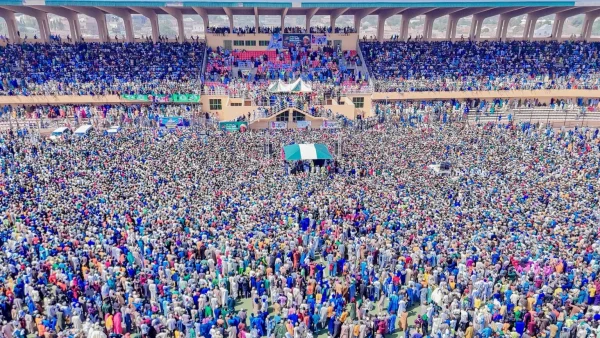
Governor, Emir, over 3 million crowd gather for Sheikh Ibrahim Nyass’ Maulud
An estimated 3 million followers of Tijaniyya Islamic Sect from within and outside the country, on Saturday, converged on Katsina for the celebration of Sheikh Ibrahim Nyass’ Maulud, 2026.
The News Agency of Nigeria (NAN) reports that the event which took place at Muhammad Dikko Stadium, Katsina, was organised by the “Majma’u Ahbab Sheikh Ibrahim Nyass”.
The Chairman, organising committee, Sheikh Muhammad Hadi-Balarabe, said that they anticipated about 4 million guests from the 36 states and the Federal Capital Territory (FCT), as well as West and North African countries.
NAN gathered that almost all hotel rooms in Katsina metropolis were occupied by those who came from far places, the situation made some residents to provide their unoccupied houses for their visitors as a demonstration of hospitality.
Those who could not afford to lodge in hotel rooms slept in the stadium in spite of the cold weather.
Before 9a.m. of Saturday, the stadium had already filled to capacity, both the seats and pitch were occupied by people, while all available surrounding spaces inside the stadium were later occupied by people.
The dual carriage road linking to the venue from the WTC roundabout up to Barhin roundabout was filled up by people.
NAN also observed that the event presented opportunities for traders, especially those selling food, water, soft drinks, herbal medicine, clothing materials, books, among others to make brisk businesses.
Addressing the gathering, Sheikh Ibrahim Dahiru-Bauchi, thanked the Katsina State Government for hosting the historic event and prayed Allah to bring lasting peace, stability and prosperity to the state, Northern Nigeria and the country in general.
In his remarks, the Emir of Kano, Alhaji Muhammad Sanusi II, urged Muslims to continue to stand firm in obeying the commandments of their creator.
He advised them to intensify efforts in seeking Allah’s forgiveness, follow the footsteps of the Prophet Muhammad (Peace Be Upon Him), endeavour to seek for knowledge, and engage in business activities to become self reliant.
Gov. Dikko Radda of Katsina, thanked the organisers for choosing his state to host the 2026 Maulud.
He appreciated the scholars for offerings prayers for peace and stability in the state and the country at large.
Radda revealed that with such prayers, peace was gradually returning to the state and urged them to sustain the prayers for the overall betterment of the state and Nigeria.
Sheikh Ibrahim Nyass’ eldest son, Sheikh Mahi Ibrahim-Nyass, represented by his younger brother, Sheikh Muhammad Ibrahim-Nyass, prayed Allah to repose the soul of the revered Islamic scholar, Sheikh Dahiru Usman-Bauchi, who passed away some months ago.
He urged the Muslims across the globe to continue to be united, love one-another and uphold the sect firmly.
A special prayer was also offered for Katsina, Nigeria and the leaders. (NAN)
-
6 years ago
Our situation in Kano terrible – Gov Ganduje cries out
-

 News12 months ago
FG pledges commitment to enhance Police officers Welfare, implement Tinubu’s 8-point agenda for NPF
-
 News11 months ago
BREAKING; NSCDC gets approval to commence 2025 recruitment exercise
-

 News9 months ago
Alleged cocaine deal: Court issues orders in suspended DCP Abba Kyari’s case
-

 News12 months ago
DPO under investigation for allegedly taking teenage girl to his home while in police custody
-

 News12 months ago
JUST IN; Commissioner of Police bows out of Service
-

 News9 months ago
JUST IN; Police Inspector dies watching Arsenal match
-

 News12 months ago
BREAKING; NLC declare nationwide protest